I am not a doctor, but we believe those two letters make anyone more credible.
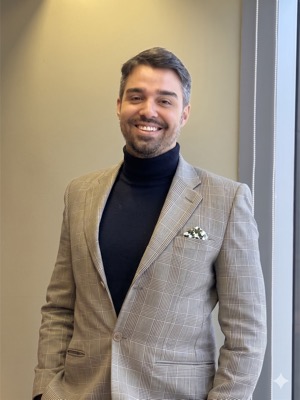
I studied philosophy and psychology under Daniel Robinson of Oxford. I have been a member or student of Masonic Orders, the Golden Dawn, the Ordo Templi Orientis, the Rosicrucians, Theosophical Society, Orthodox Yeshivot, Kabbalistic and Chassidic Groups. I have worked in languages most of my life: Ancient Hebrew, Aramaic, Greek, Latin, and Sanskrit. In my spare time, I research Artificial Intelligence, Theoretical Physics, Consciousness Theory and many of the other subjects in our framework.
Professionally I have worked as an entrepreneur, in marketing, and in executive communications. I have written for newspapers and magazines and interviewed over 150 intellectuals, politicians, and public figures on my podcast. I have two children and I’m an imperfect father, learning how to edify the human soul in real-time.
I practise meditation, yoga, prayer, and self-hypnosis daily. The methods explored in this work have been tried and tested personally.
I consider that I have lived a life of practical pistomechanics. The disciplines catalogued in the Sources are not abstractions to me.
The list of memberships above is a record of searching. The secret societies held real machinery, wrapped in mystical language and secrecy. Both wrappings were political necessities in the centuries that built them, and both are dead weight now; I understood the caution and left. Magick stripped some of the costume and kept the skeleton that produced it: the self-glorification, the hierarchies, the deliberate omissions of the lodge structure it grew from. Philosophy had the opposite problem. The modern academy is far from Pythagoras’ community, Epictetus’ drills, and Plato’s Academy, where philosophy was a formation and not a publication record. I found glory-seeking there too, with its head in the clouds, and I left that as well.
Judaism and Kabbalah were the greatest frameworks I found, and I stayed. But the tradition holds its walls by design. The Kabbalist cannot learn beside the Neoplatonist for fear of idolatry, though Rabbi Meir kept the Cynic philosopher Oenomaus of Gadara as a friend. Even where the Spanish rabbis of the fourteenth century read the outside sources, the club remained private. I think the walls are right for the tradition that keeps them. They are politically earned. And they leave the rest of humanity outside.
Pistomechanics is what I always wanted and could not find: the machinery of the societies without the lingo or the secrecy, the practice without the hierarchy, philosophy applied the way the ancients applied it, and the depth of the received tradition with the doors open. My professional life in communication and sales, and my private life in theology and comparative religion, turned out to be one study. This work is where the two halves meet.
What brought me to build pistomechanics as a discipline was a pattern I kept encountering. Behind every well-intentioned movement lies a consistent structural problem: the need to dominate over competing beliefs. Religious orders, political movements, therapeutic schools, commercial persuasion systems, and esoteric traditions each carry within them the assumption that their belief should displace the others. Science attempts to displace religion. Religion attempts to displace science. Both attempt to displace whatever falls outside their framework. The mechanics of displacement are always the same.
I came to believe that only a deep understanding of the structure of belief itself can emancipate a person from the passivity of unchecked influence — not by rejecting all belief, which is impossible, but by seeing the machinery while it runs. That is what this project attempts to make possible.
*I used AI to add a turtleneck to my photo, because we believe turtlenecks exude “calm authority.”